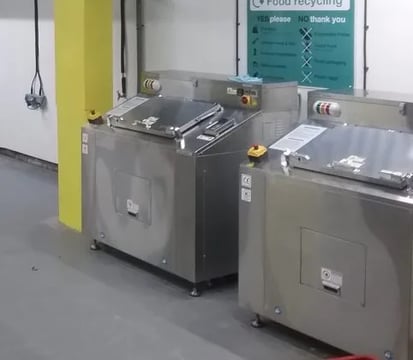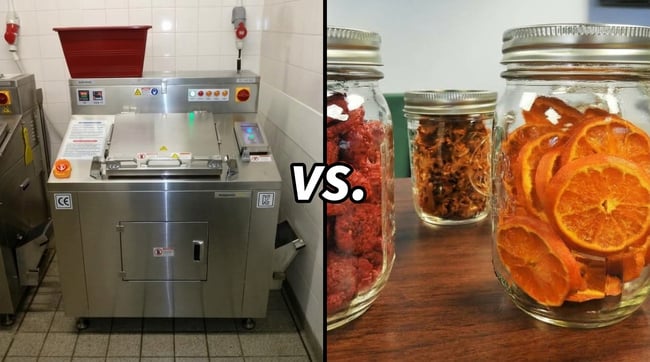
Commercial waste management and catering operations frequently use the terms food waste dryer and food dehydrator interchangeably. Although both technologies rely on thermal evaporation, they target entirely different objectives, handle completely different inputs, and produce vastly different end results.
For businesses, local authorities, and facilities managers aiming to lower waste handling fees and meet UK sustainability goals, understanding these operational distinctions is essential before investing in machinery.
Key Differences at a Glance
|
Feature |
Food Dehydrator |
Food Waste Dryer |
|
Primary Goal |
Preserves edible food for culinary consumption |
Reduces waste volume and weight for disposal or recycling |
|
Input Material |
Sliced, uniform, fresh ingredients |
Unsorted, mixed food scraps, plate waste, and kitchen prep waste |
|
Processing Method |
Static heat and gentle horizontal airflow |
High heat paired with continuous mechanical agitation |
|
Output Type |
Dried snacks, fruit slices, or food ingredients |
Sterile, dry biomass powder reduced by up to 90% in volume |
1. Culinary Preservation vs. Commercial Waste Volume Reduction
The foundational difference between these two technologies comes down to intent:
- Food Dehydrators: Designed as food prep appliances, standard dehydrators use controlled, low heat (typically between 35°C and 70°C) to gently extract moisture from fruits, vegetables, meats, and herbs. The primary objective is preserving nutrients, texture, and flavour while extending shelf life for human consumption.
- Food Waste Dryers: Built as heavy duty waste management equipment, commercial dryers focus strictly on mass and volume reduction. By running at elevated temperatures (often reaching 80°C to 100°C+), they vaporize moisture which accounts for roughly 80% of raw organic waste mass significantly shrinking the physical volume left for collection.
2. Machinery Mechanics: Static Trays vs. Heavy Duty Paddles
How ingredients or waste enter and move through each unit differs fundamentally:
- Dehydrator Mechanics: Staff must manually prepare food, slicing items uniformly and spreading them evenly across fixed mesh trays. Low velocity air circulates across the surfaces without disturbing the produce.
- Waste Dryer Mechanics: Kitchen staff dump mixed food scraps, plate scrapings, and prep waste directly into the processing chamber. Internal heavy duty paddles constantly rotate, breaking down dense materials and ensuring rapid thermal transfer across the entire waste load.
3. Hygiene Standards and Odour Control
Managing decomposing organic waste requires specialized environmental controls that culinary appliances do not feature:
- Hygiene & Pasteurisation: High internal temperatures pasteurise the waste, destroying harmful pathogens and bacteria while neutralizing unpleasant decomposition odours.
- Vapour & Drainage Management: Rather than releasing damp, foul smelling air into the kitchen, commercial food waste dryers condense the rising steam back into liquid water discharging it straight into standard drainage while passing exhaust air through internal carbon filters.
4. Output Characteristics: Food Stuff vs. Bio-Feedstock
- Dehydrator Output: Dried fruit snacks, jerky, or dehydrated herbs ready for table service or food preparation.
- Food Waste Dryer Output: A sterile, consistent, dry biomass powder. Although high heat renders it biologically inactive (sterilising beneficial soil microbes), this dry material serves as a stable, odourless soil conditioner, biofuel source, or high value feedstock for anaerobic digestion plants.
Which Equipment Does Your Site Require?
If your goal is culinary preparation and preserving ingredients, a standard food dehydrator is the right option. However, if your facility is dealing with heavy wheelie bins, escalating collection invoices, and foul waste store odours, a dedicated commercial food waste dryer is the purpose-built equipment engineered to cut your site's waste volume by up to 90%.